The key distinction
A right to take possession is not a duty to dispose.
When the days grow shorter and rush-hour traffic coincides with twilight, encounters between wildlife and vehicles become particularly likely. After a wildlife collision, the police normally notify the This is the person entitled to exercise hunting rights in the affected hunting district, for example its lessee or an owner who hunts their own estate. Holding a hunting licence alone does not make someone the holder of those rights.. But must that person collect every dead animal? And may a motorist take a deer killed in the collision?
The key distinction is between the right to take possession, responsibility for injured game and the removal of an animal that is already dead. These tasks should be kept clearly separate, particularly when a hunting lease is advertised or renewed.
Who is responsible? ↓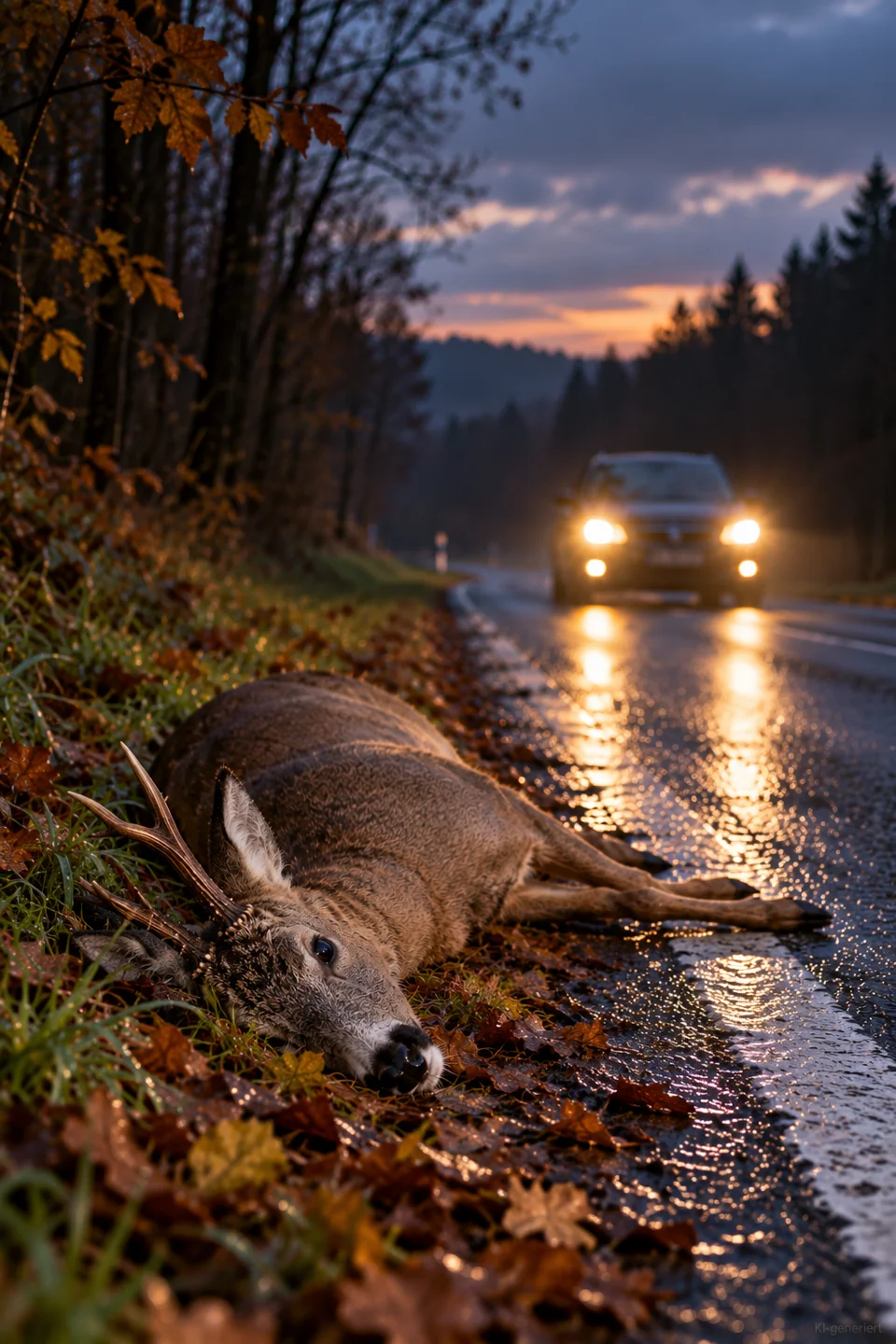
Take possession
The holder of hunting rights may take possession of dead game. This does not automatically entail a duty to collect it.
Assist
Injured game requires prompt attention to animal welfare and, where needed, competent tracking.
Remove
On public roads, the road authority is responsible once the appropriation right is declined.
The right to take possession: Who owns a deer killed on the road?
A right to take possession, not an automatic duty to collect.
Under § 1 Abs. 5 of the Federal Hunting Act (BJagdG), hunting rights include the exclusive right to take possession of sick or dead game, including game found dead. In a hunting district, this right generally belongs to the holder of the hunting rights.
A right to take possession is neither ownership nor an automatic duty to collect the animal. Wild animals living freely are generally ownerless. A collision alone does not make the animal the property of either the motorist or the hunting lessee. Lawful appropriation is what matters for acquiring ownership.
The holder of the hunting rights may decline to take possession of a deer killed in a collision. The appropriation right alone therefore does not establish a general obligation to recover and dispose of every dead wild animal.
Legal basis: § 1 BJagdG and § 960 BGB.
Who must remove dead game from the road?
If appropriation is declined, the road authority is responsible.
In Bavaria, Nr. 10.6 of the police guidelines for recording road traffic accidents sets out the procedure following a wildlife collision. If a wild animal has been killed or injured, the holder of the hunting rights must generally be notified without delay.
If the holder declines to exercise that right, the authority responsible for the road, or its appointed contractor, must be notified. That authority or contractor is then responsible for removing the carcass. The competent authority depends on the road concerned.
The Bavarian guideline therefore expressly distinguishes voluntary appropriation from subsequent disposal. A hunting lessee does not automatically become a carcass removal service merely by holding the appropriation right.
Source: Police guidelines for recording road traffic accidents, Nr. 10.6.
What if the animal is in a roadside ditch?
The location matters.
The decisive question is not simply whether the animal lies on the asphalt or a few metres away. Ditches, drainage facilities and embankments can also form part of a road. Such a location may therefore fall within the road authority’s area of responsibility.
Whether a particular area forms part of a public road must be established in the individual case. For Bavarian roads, Art. 2 BayStrWG lists the components of a road. Federal trunk roads are additionally subject to the road legislation applicable to them.
If the animal lies well away from a public road in woodland or a field, the rules concerning carcasses from road accidents cannot simply be transferred to that situation. Particular legal provisions or official orders may nevertheless require action.
What if the animal is still alive?
Preventing suffering comes first.
For a severely injured wild animal, the priorities are preventing unnecessary pain and suffering and arranging the necessary care or humane killing. Questions about subsequent disposal must not delay necessary assistance.
§ 22a BJagdG requires wounded or seriously ill game to be killed without delay unless capturing and caring for it is sufficient and possible. Animal welfare law and the relevant hunting authorisations must also be observed.
Following a collision, the police should notify the holder of the hunting rights without delay. If the animal has fled, professional tracking may be necessary. Where it crosses a hunting district boundary, the rules on pursuing wounded game apply. Authorised tracking teams can assist.
Preventing animal suffering and disposing of an already dead animal are different tasks.
Read more: Tracking teams and telephone numbers, § 22a BJagdG and Art. 37 BayJG.
Must the hunting lessee be available around the clock?
Reliable arrangements rather than blanket response times.
The provisions discussed here do not establish a general maximum travel time of, for example, 15, 30 or 60 minutes for every hunting lessee. Nor do they establish a blanket requirement for personal round-the-clock availability for every report of an animal that is already dead.
This does not release the holder of the hunting rights from their legal duties. The measures required depend on the situation, the applicable rules and any contractual commitments. In particular, reliable arrangements must enable prompt action when game is injured.
Authorised local hunters, officially confirmed game wardens and suitable tracking teams can contribute. Responsibilities, cover arrangements and contact details should be coordinated with the police and others involved. A longer journey alone does not establish that a lessee cannot fulfil their responsibilities.
What may hunting associations agree in a lease?
Separate legal duties from additional commitments.
In a tender, it is sensible to ask how applicants would organise assistance for injured game and cooperation following wildlife collisions. That must be distinguished from taking on additional recovery and disposal services.
A tender does not in itself change statutory responsibilities. Additional contractual services may, however, be agreed where legally permissible. An agreement between the contracting parties does not automatically replace the public-law duties of other authorities.
Applicants should therefore examine exactly what they are promising. A blanket commitment to recover and dispose of all dead game at any time may go considerably beyond statutory duties. Busy roads can substantially increase the time and cost involved.
A clear agreement distinguishes between:
- Assisting injured game and arranging necessary tracking
- Receiving and passing on reports
- Voluntarily taking possession of dead game
- Legally required disposal of animal bodies
- Additional agreed services, their payment and cover arrangements
Before signing: Our forms page with the official hunting lease template provides a starting point. Clauses on dead game, responsibilities, costs and additional commitments should be clearly recorded in the individual contract and legally checked where anything is unclear.
May a motorist take the deer killed in the collision?
A collision does not confer a right to take the animal.
Not without the appropriate permission. Hitting a deer does not confer a right to take possession of it. Unauthorised removal can have criminal consequences, particularly under § 292 StGB on poaching. This also applies to game that is already dead.
Secure the accident scene and notify the police after a wildlife collision. If people are injured, call 112. Do not handle or transport injured wild animals yourself, and do not simply take dead game away.
Practical steps are set out on our page What to do after a wildlife collision. Legal basis: § 292 StGB.
What about dead game in woodland or fields?
Consider the circumstances and disease risks.
Not every dead wild animal automatically has to be recovered. Death and decomposition are part of natural processes. Here too, the appropriation right alone does not create a general duty for the hunting lessee to collect every animal.
This does not mean that animal bodies may be left wherever they are in every circumstance. Suspected animal disease may trigger particular reporting, examination and disposal duties. Risks to people or animals and official orders must also be taken into account.
Do not handle a suspicious carcass without protection. Record its location and agree the next steps with the competent veterinary authority. Reporting information is available under Wildlife monitoring and ASF carcass monitoring.
A right to take possession is not a disposal order
Clear responsibilities help everyone involved.
The holder of hunting rights may generally take possession of dead game. This does not automatically entail a duty to collect every animal body. For wildlife collisions on public roads in Bavaria, the police guideline expressly sets out the procedure when that right is declined.
Where game is injured, the priorities are animal welfare, competent assistance and, where necessary, tracking. Hunting leases should clearly separate these legal duties from additional services.
Responsible holders of hunting rights cooperate with the police, public authorities and road authorities. Reliable arrangements help everyone involved. They do not, however, automatically make the hunting lessee responsible for every carcass in the district.
Legal sources and further information
Official sources for further reading.