
What hunters need to know
In 2026, examinations of red deer from the Hohenfels military training area found Sarcocystis parasites together with inflammatory and greenish changes in muscle tissue. The Neumarkt Veterinary Office reported on the state of the investigation on 27 October 2026. Further samples were to be examined by the Bavarian State Office for Health and Food Safety, including identification of the exact parasite species.
The issue also concerns roe deer. Sarcocystis parasites are common in wild ruminants. A light infestation usually causes no visible changes and often cannot be detected with the naked eye. A heavy infestation, however, can cause marked changes in muscle tissue.
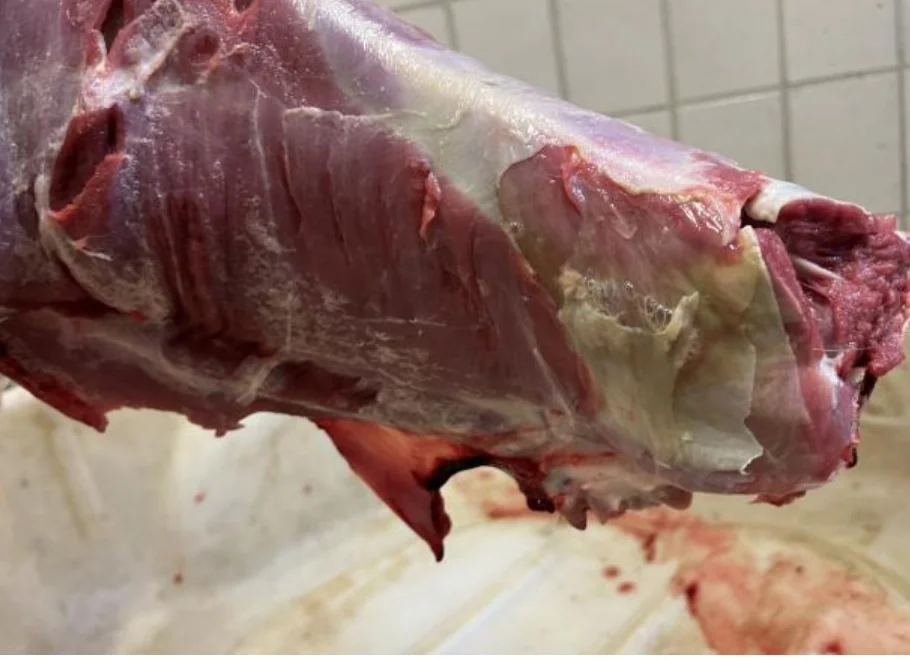
Cover image: Noticeable greenish change in the muscle tissue of red deer from the Hohenfels military training area. Source: Neumarkt Veterinary Office, presentation dated 27 October 2026.
The key rule in practice: If a carcass shows substantial or unusual changes in the muscles, it must not simply be processed further, supplied to others or eaten. It must be reported to the Veterinary Office for an official meat inspection. This also applies when the meat is intended only for personal consumption.
What are Sarcocystis parasites?
Sarcocystis are single-celled parasites. Their life cycle requires an intermediate host and a definitive host. Red deer and roe deer can act as intermediate hosts, with cysts forming in their muscles.
Carnivores such as foxes, dogs or cats can be involved as definitive hosts. If they eat raw infested meat, the parasite's life cycle may continue. Infectious stages are shed in faeces and can then be ingested by wild ruminants.
Why roe deer must be included
In 2020, the Baden-Württemberg investigation offices reported on two couples who temporarily developed vomiting and diarrhoea after eating cooked roe-deer meat. The samples contained an exceptionally heavy infestation with Sarcocystis cysts. Such cases are considered rare.
In 2025, the CVUA Freiburg also examined roe-deer muscle showing large, clearly defined whitish and greenish areas. The examination found severe inflammation and a heavy infestation with Sarcocystis cysts.
These cases show that marked muscle abnormalities in roe deer must also be taken seriously.
What to look for during field dressing and processing
Warning signs may include:
- large whitish or greenish shimmering areas in muscle meat,
- greenish discolouration of muscle membranes,
- unusually pale, soft or jelly-like muscle tissue,
- clearly inflamed or otherwise substantially altered muscle tissue.
These changes can have different causes and do not by themselves prove a Sarcocystis infestation. A professional examination is therefore necessary.
What to do with a suspicious carcass
- Do not process, supply or eat the carcass.
- Store it separately and keep it sufficiently chilled.
- Contact the Veterinary Office and report the animal for official meat inspection.
- Agree the next steps and required samples with the Veterinary Office.
- Do not feed suspicious raw meat or raw game remains to dogs or cats.
Heating and freezing
The German Federal Institute for Risk Assessment advises heating meat sufficiently before consumption or freezing it at minus 20 degrees Celsius for at least three days. The CVUA Freiburg specifies at least 71 degrees Celsius for two minutes for complete heating.
These recommendations concern the safe handling of meat. Where visible changes raise health concerns, heating or freezing does not replace an official meat inspection.
Contact
Neumarkt Veterinary Office
09181 / 470-1421
veterinaeramt@landkreis-neumarkt.de
Sources and further information
- Neumarkt Veterinary Office, Dr Sonja Forster: presentation “Sarcocystis in red deer”, information dated 27 October 2026.
- CVUA Freiburg: Sarcocystis in game meat ↗
- CVUA Stuttgart: Sarcocystis in roe-deer meat ↗
- German Federal Institute for Risk Assessment: Sarcocystis ↗
Note: This article reflects the information available on 30 October 2026. In a specific case, the competent Veterinary Office decides on the next steps.